
A teacher in New York decided to honor all of her high school seniors by telling each of them how much of a difference they made. Using the Who I Am Makes A Difference Ceremony, she called each student to the front of the class, one at a time. First she told the class how that student made a difference to her. Then, she presented each of them with a Who I Am Makes A Difference Blue Ribbon.
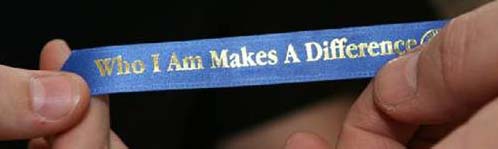 Afterwards the teacher decided to do a class project to see what kind of impact acknowledgement would have on their community. She gave each of the students three more ribbons and instructed them to go out and spread this Blue Ribbon Ceremony. They were to follow up on the results, see who honored whom and report back to the class in about a week.
One of the boys in the class went to a junior executive in a nearby company and honored him for having helped him with his career planning. The boy gave him a Blue Ribbon, placing it on his shirt just above his heart. Then he gave the junior executive two extra ribbons, and said, “We’re doing a class project on acknowledgement, and we’d like you to go out and find someone to honor. Give them this Blue Ribbon, then give them the extra Blue Ribbon so they can acknowledge another person to keep this acknowledgement ceremony going. Then, please report back to me and tell me what happened.”
Later that day the junior executive went in to see his boss, who had been noted, by the way, as being kind of a grouchy fellow. He sat his boss down and told him that he deeply admired him for being a creative genius. The junior executive asked him if he would accept the gift of the Blue Ribbon and would he give him permission to put it on him. His surprised boss said, “Well, sure.”The junior executive took the Blue Ribbon and placed it right on his boss’ jacket above his heart. As he gave him the last extra ribbon, he said, “Would you do me a favor? Would you take this extra ribbon and pass it on by honoring someone else? The young boy who first gave me the ribbons is doing a project in school and we want to keep this recognition ceremony going to find out how it affects people.”
That night the boss went home to his 14-year-old son and sat him down. He said, “The most incredible thing happened to me today. I was in my office and one of the junior executives came in and told me he admired me and gave me a Blue Ribbon for being a creative genius. Imagine. He thinks I’m a creative genius. Then he put this Blue Ribbon that says Who I Am Makes A Difference on my jacket above my heart. He gave me an extra ribbon and asked me to find someone else to honor. As I was driving home tonight, I started thinking about whom I would honor with this ribbon and I thought about you. I want to honor you.
“My days are really hectic and when I come home I don’t pay a lot of attention to you. Sometimes I scream at you for not getting good enough grades in school or for your bedroom being a mess. But somehow tonight, I just wanted to sit here and, well, just let you know that you do make a difference to me. Besides your mother, you are the most important person in my life. You’re a great kid and I love you!”
The startled boy started to sob and sob. He couldn’t stop crying. His whole body shook. He got up, walked over to a drawer, opened it and took out a gun. Holding the gun in his hand, he looked up at his father and through his tears he said, “I was planning on committing suicide tomorrow, Dad, because I didn’t think you loved me. Now I don’t need to.” This is the “Who I am Makes a Difference Story” Copyright ©2006 Helice Bridges.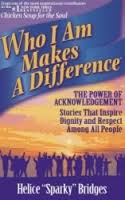
I bet there is not one of is the sanctuary tonight who has not had a feeling of loneliness, alienation, of despair, of humiliation. We all have those feelings. We have them, our family members have them, our friends, our teachers, our co-workers, strangers sitting next to us have them, our cantors and rabbis have, and our prophets had them. After all, we are all human.
This afternoon we will read about the prophet Jonah, who is best known, as the prophet who was swallowed up by a whale. Jonah was sent on a mission he didn’t want to go on. He was sent to speak God’s message to the Ninavites and to tell them to repent from their misguided deeds. Do you know one of the ways to tell a real Prophet from a false prophet? They don’t want the job. They are afraid to go out and speak the truth. They know people will laugh at them, make fun of them, or ignore them altogether and humiliate them. “God!” The real prophet pleads” choose someone else! Don’t pick me!” The limelight isn’t for them—they want to be left alone. They don’t want the spotlight and they also are afraid that God might not always ‘have their back.” Jonah cried to God and begged not to be accountable to God, “O God! Isn’t this just what I said when I was still in my own country? This is why I [I tried to runaway.] In the Book of Jonah we read, “For I know that You are compassionate and gracious, slow to anger, abounding in kindness, renouncing punishment. Please, God take my life, for I would rather die than live.” God replied, “Are you that deeply grieved?” [Jonah 4:2-4] and a little bit later, at the end of Jonah’s mission, when it was over, Jonah begged for death after the plant that sheltered him from the sun, had died.
What Jonah felt, although he accomplished what God had asked of him, was not just alienation, Jonah felt utter despair and tried to hide and put an end to his misery. He did not understand that these feelings would be temporary. Thankfully he could not hide and was saved, he was rescued. God followed Jonah, and would not leave him. Jonah had a follower, one who knew Jonah’s mindset and knew of Jonah’s desperation. It is so tragic that so many are not saved, so many are not as fortunate. Many remain alone and symptoms remain unnoticed, people take their own lives because they can not see that this too might pass. They are in the depths of despair, alone, and there is a mental illness preventing them from recovery on their own.
My husband Kyle related a story to me about a commute he shared with one of his judges from work. The red line L train was being delayed during the evening rush by a jumper – that’s slang for a suicide committed by someone who jumps in front of a train, which is not an uncommon occurrence. Kyle’s judge made a joke that she wished these jumpers would have the courtesy to jump at off hours as not to delay her trip home. Kyle, who generally does not shy away from tasteless humor, replied somberly that it is unfortunate that people feel so defeated and powerless that they plan their final act to impact as many people as they can. If we don’t think we make a difference in life, perhaps we think at least we will make a difference in death. It is a profound human tragedy that one’s inner sense of worthlessness can snowball unchallenged to the extent that it warps the mind to conjure this deranged idea and it doesn’t have to be so. We need to let others know that who they are in life makes a difference. Think about that story I told a few moments ago about the father and his son.
In my ethical will to my kids, I shared with you on Rosh Hashanah I wrote to them that when experiencing frustration if the pain is disproportionate or does not seem to diminish over time, we want them to see a professional about getting help about it – that life is too precious to be victimized by that which is beyond our control. I realize that people can feel a hurt that is so acute that death seems like the only option. I recognize that for some suicide seems like an option to deal with unbearable inner torment, but please exhaust all other possible options first! There are so many therapy models, medications, studies and varieties of spiritual practices that help people overcome the unconscionable–and we can let our loved ones know, exhaust all possible options first. And when you think you have, keep looking for more options. Yet, I would be remiss, if I did not also add, that even if we do our very best at trying to prevent one from taking his or her life, we can only do what we can do and there is much that is beyond our control. Indeed, there is much at play, and we must then know, we cannot blame ourselves.
- Suicide is the second leading cause of death for ages 10-24. (2010 CDC WISQARS)
- More teenagers and young adults die from suicide than from cancer, heart disease, AIDS, birth defects, stroke, pneumonia, influenza, and chronic lung disease, combined. (2010 CDC WISQARS)
- Each day in our nation there are an average of over 5,400 suicide attempts by young people grades 7-12. (2010 CDCWISQARS)


In an article on Huffington Post website titled, Food for Thought on Yom Kippur: Suicide and Mental Illness, world renowned expert on suicide bereavement Joanne Harpel wrote,
“Virtually everyone who hears about a suicide asks the same question: Why? It’s a natural instinct to want to make sense out of the seemingly inexplicable. Taking one’s own life violates a fundamental belief we hold as human beings — and as Jews — that life is sacred. I’m often asked whether suicide is a “choice,” and of course in some literal sense it is. Yet it’s a decision profoundly influenced by the hopelessness, distorted thinking, and compromised decision-making that can result from serious mental illnesses. The Mi Shebeirach, a Jewish prayer for healing, speaks of “the renewal of body, the renewal of spirit.” While it’s reflexive to think of those battling cancer or recovering from a stroke or accident, it’s equally important to remember those among us who are suffering from illnesses like depression, untreated [addiction] or psychotic episodes which profoundly affect both body and spirit. On Yom Kippur, we recite the sobering Unetanah Tokef, contemplating who shall perish by water and who by fire, who by famine, earthquake, plague. And who shall be at peace and who shall be tormented — who shall be in such excruciating pain that they’ll die by their own hand.” (http://www.huffingtonpost.com/joanne-l-harpel-mphil-jd/suicide_b_5902540.html
Yom Kippur is about going deep with in to the recess of our hearts as individuals and as a sacred community to say we are sorry. As individuals and as a community we accept apologies. And we turn inward. The pain and the suffering we might feel is to be acknowledged, and if it is too much for us, we can get help. If we know that there is someone struggling offer help. It is our obligation and our responsibility.
Again, Joanne Harpel, 1. Research shows that over 90 percent of people who kill themselves have a diagnosable (albeit not always diagnosed or adequately treated) mental illness at the time of their death, most often depression, bipolar disorder, schizophrenia, substance abuse, or a combination. Among young people, add conduct and eating disorders to the list; in the military community, add PTSD and the effects of traumatic brain injury.
Suicide is not a sign of weakness. It is a sign of something else; disease, an illness like cancer or diabetes. It is a sign of a mental illness and we as a community, as friends, partners, people who care will wake up to the signs, calls and silent messages that might be around us. Depression can mask itself in various forms. It doesn’t have to be tears and sadness; it can be anger and aggression, withdrawal, or even slurred speech and unresponsiveness. It is our job not to diagnose but rather to Wake up and pay attention to others around us. Ask how people are doing and stick around, wait for their answers, and be a loving, non-judging presence. And never miss an opportunity to tell people that who they are makes a difference, it can be a lifesaver.
In addition to the increasing rates of suicide among young people I would also be remiss if I did not mention the disturbing increase in bullying and drug abuse happening in our community. While the direct correlation to these two facts and the increase in suicide is subject to debate, they are happening and Your rabbis are concerned. Beth Am is committed to being part of the solution. We want our teens and all our children to know that if the are in trouble or need help we are here for them. And more then that we are a place who lifts them up and teaches them that they are loved by an unending love not for what they do, but for who they are.
For many years I served on the Advisory Council of the Chicago Jewish Healing Network and I now serve on the Advisory council to its Jewish Center on Addiction. The center on Addiction has just been awarded a three-year grant to work with Jewish teens and middle school students on Drug and Alcohol prevention. The grant, called Partners in Prevention was created and developed by Beit Teshuva, a premier twelve- step recovery house, center and synagogue based in California, founded and led by Rabbi Marc Borovitz a nationally recognized expert in spirituality and twelve-step recovery. The Jewish Center on Addiction put out a call to area organizations and synagogues to become a partner with Beit Teshuva and train to bring the Drug Prevention program to this community. I am thrilled to announce that Congregation Beth Am will one of the three Chicagoland area organizations and the only synagogue to be trained to become a Partner in Prevention. Next month, Rabbi Prass and I will attend training sessions facilitated by Rabbi Mark Borovitz, and Doug Rosen, Beit Tshuva’s Director of Youth Services and we will bring this program to Beth Am and we will share it with the entire northwest suburban Jewish community. It is that important. Details will be forthcoming. I know I also speak for Rabbi Prass when I say that we consider your children to be as important to us as are our own. We are part of your village in raising the kids, all of our kids. And if we can prevent even one of our kids from feelings of despair and alienation than we are successful. Our rabbis teach, “To save one life is to save the entire world.”
We are losing too many children, too many loved ones and we are more committed then ever to work with you to help our kids know that who they are makes a difference.
Friends. Coming around right now is a ribbon that says just that. Now, like the father who received this ribbon and gave it to his son, you have your own ribbon. Wear it. Pass it on, let me know if you want more. In 1980, the “Who I Am Makes A Difference”® Blue Ribbon Acknowledgement Ceremony was created to help people express their appreciation, respect and love for their children, parents, teachers, friends, neighbors—everyone! Over the years, this heartfelt ceremony has impacted over 40 million people worldwide and has been translated into 12 languages — saving lives, eradicating bullying, and making dreams come true in the home, school and workplace. Helice “Sparky” Bridges founded Difference Makers International, and IGNITE WHAT’S RIGHT™…Giving Youth A Voice for Change to eliminate bullying, enhance self-worth and make a positive contribution in the community and world! Because we need to know that we matter… That we make a difference. And we are not going to know this unless we are told. The world would not be the same with out us.
Let’s start tonight. Let’s start recognize that mental illness exists and we are not exempt from it. We can get help and so can our loved ones. We can help be agents of change. Let’s start challenging those secret voices of despair and alienation, of self-hate and isolation, of loneliness and hurt. Let’s start recognizing those around us and telling them that they mean something to us. Speak a kind word, tell someone they made a difference to you and share a ribbon.
Beth Am is here to help bring healing into this world. May we bring healing and hope into our own lives and in our community. For indeed, we are loved now and always, just the way we are.
May all of us be inscribed for a year of life, in the book of Life. Amen.




 this was first posted on osrui.urjcamps.org

 Ayin Tova: To See The Good
You must be logged in to post a comment.