Silver Platter

Se’mu Lev: Pay Heed
Day One:
It was a truly beautiful day filled with awe-inspiring moments, facts, tours, descriptions, long walks, new sights and smells and… a day that required stamina and patience. See, there was a massive labor strike in Israel over the proposed layoffs of 1700 workers at Teva Pharmesutials, the largest generic drug company in the world and every segment of the population in Israel was affected by the strike, including the airport where the passport workers struck from 8am-noon. This mayhem and other odd travel adventures resulted in plenty of exhausted, weary travelers and changes to our Day 1 itinerary. While waiting close to 2 hours in the airport for the second half of our group to arrive, Gabi, my 16-year-old mentioned that one of her favorite sayings is Se’mu Lev: Pay heed. Pay Heed–Pay attention, don’t miss anything and everything is important! Pay heed–we might not have planed the day the way it turned out… but don’t ‘zone’ out, don’t miss it, even if you don’t like it. Se’mu Lev: Be where you are. Be present.
There is a beautiful Piyut, liturgical Poem Odeh LEl which perfectly expresses the idea of Semu Lev: Pay attention to your own soul. She is beautiful and calls to you. And as my friend Rabbi John Bush reminds me, Se’mu Lev–“put your heart into it” Pay close enough attention that you can hear the call and prayers of your heart and the whispering of your soul.
One of the stops we made today, Independence Hall deeply touched my soul. On this 6th night of Hanukah, the retelling of how David Ben Gurion declared Israel a state was reminiscent of the Maccabean struggle. Our museum docent was incredible and the story of the founding of this Country in the midst of war, hatred, alienation, and destruction is quite simply… a miracle. At the end of the tour we sang Hatikvah, the Israeli national anthem and there were tears shed by many of us. Although words today like “homeland” have great political conotations, I also recognize that Israel was born out of great necessity and remains a haven for Jews fleeing hatred and persecution. When paying heed to this story I can feel the miracle of the birth of the State of Israel in my kishkes–from deep within.
Also, knowing that for one-day thousands and thousands of Israelis went on strike and shut down the country today in solidarity with 1700 people also reaches me and reminds me that sometimes, family does support family. Yes, not always, in fact not even most of the time here, but every so often, they get it right.
Se’mu Lev~ today was indeed a day to pay heed.
Greetings from Tel Aviv.
Israel: Before the Tour!
We landed early this morning and after a relatively easy flight and travel and arrived from Zurich at 3:45. ARZA/DAAT Travel took good care of us so that we were able to check into our room early and sleep before indulging in the incredible Israeli hotel Breakfast which Nathan has been looking forward to breakfast since we last were last here in 2015! We then went on a guided walking tour of the Neve Tzedek neighborhood, founded in 1888, before Tel Aviv was built and is now known for its narrow winding streets and is home to some of Israel’s finest theaters, dance companies, and art houses. We finished the tour at the Tel Aviv old train station and park and Gabi and I said good-bye to the rest of the Bellows and their grandparents and headed for the Hotel. Gabi is doing well and is looking forward to being pain-free after she has microdiscectomy surgery soon after we return home. She is a great sport and is going to do as much of the tour as she can. she knows that while here in Israel she is free to go to her fav coffee shop, Aroma and do homework or go back to the hotel to rest.
We are quite fortunate that the kids consider Israel as one of their homes: Lucy is trying to speak only Hebrew and is making a vlog (video blog) and Nathan is soaking everything up and offering us a great deal back!
I am re-experiencing, through the kids, what it first felt like to be in Israel, to touch ground on this land. As one kid said to me this morning, “Everyone looks like me here.” Whether literally true or not—she expressed a feeling that I first had decades ago when coming to Israel at 16 years old. There is a comfort level here for them, a sense of belonging, of fitting in, they feel they have a place in this world and as much as I want to talk about Reform Judaism in Israel and pluralism (and I will)…. I know what she means. There will be plenty of time to experience the reality of what it means to be a Reform Jew in Israel and to talk about the politics here and the deep levels of discrimination experienced by many. But For now, on this 4th day of Hanukkah, it is so awesome to witness the miracle of our People, this Land, and my children who feel a connection to this land and the ancestors.
Our Congregation Beth Am Tour officially begins tomorrow! Shavua Tov and Happy Hanukkah!
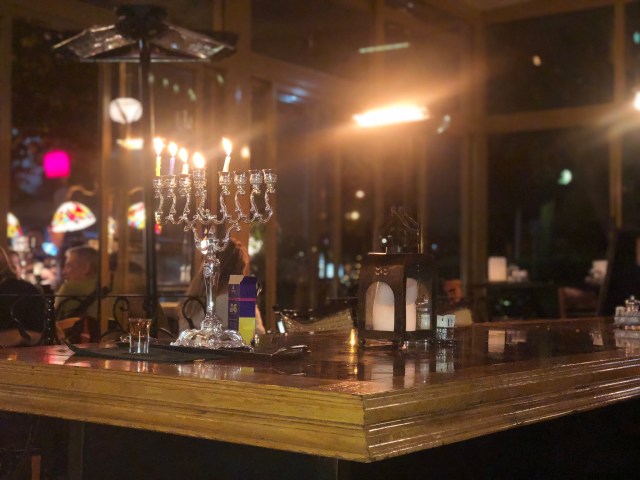
Happy Hanukkah on Dizengoff street:
sunset view from hotel room:
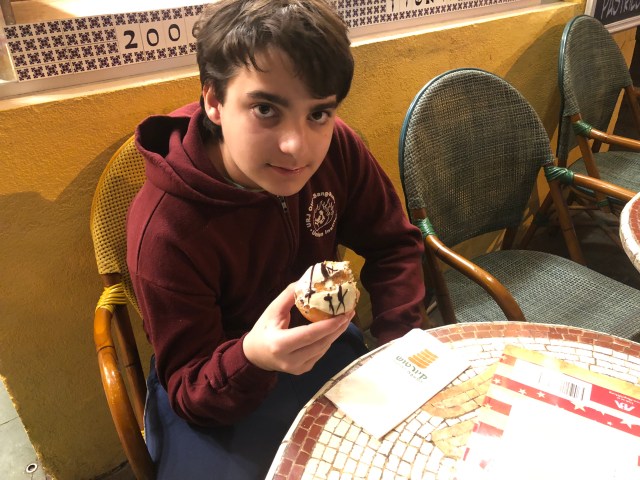
Nathan and his first Sufganiah in Israel:
We Stand Here Today: The Trajectory of A Blessed Shul
In 2012, I stood before you and shared that I often feel like I am living in a Bible story, at that time I admitted that I felt as if I was living in Exodus when God commanded, Asu Li Mikdash, “build for me a sanctuary.” God said to Moses, “Tell the people they should build for me a sanctuary, so that I may dwell amongst them.” God did not say, “build a sanctuary for me that I might dwell with in it,” God said, “so that I might dwell amongst them.” At that time in Beth Am’s history, we were preparing to leave our treasured building and it was to be the second to the last High Holidays we would spend under the Beth Am Jewish Star cut-out from the high ceiling that was once in this very place. Back then as a congregation, we studied and shared about the meaning of Asu Li Mikdash, V’shocahti b’tocaham, “Build for me a sanctuary and I will dwell amongst them.” We learned about how God doesn’t need the edifice, rather, we are taught, God dwells among and within us and that we take God with us where ever we go. For how could this not have been our story at that time? We had just put 225 North McHenry Road–this building, then Congregation Beth Am’s home, on the real estate market and there were so very many unknowns. It was a time of grieving, of saying good-bye, of feeling scared about the future of our congregational family. We faced our reality with strength, even though it was so very difficult. Ultimately, we saw that a synagogue is nothing but four walls and an ark—it is the people that make the community, it is the people that give us life and sustain the congregation. We are now five years from that sermon. We have settled into Abbott Court. It has become our home where we worship, learn, teach, meet, play, draw, meditate, practice yoga, repair and find refuge; Beth Am is a true sanctuary in a broken, complicated world.
Asu Li Mikdash-was our story for a few years, and then in 2014 I stood before you and offered a different biblical story I felt I was living in. It’s not exactly a biblical story, it’s a midrash–a teaching of the rabbis, not found in the Torah. It is the Nachson story. The rabbis teach us that when the Israelites reached the Red Sea it did not automatically part. Frozen with fear, the Israelites stood at the banks of the sea crying out to God for help. With the Egyptians quickly encroaching and the waters not yet parting, Nachson, a man of faith and bravery, entered the waters. Only when the water reached his neck did the sea finally part and the Israelites marched on to liberation. Nachson. Fearless. Faithful. Courageous. Risk Taker.
In 2014, Beth Am, like Nachshon took the first step into the water, eventually walking across dry land into safety. With wholeness, solvency, creativity, awareness and kavanah – intention, we gingerly stepped into an exciting, purposeful future. We walked together striving to create a flourishing community that like all synagogues and houses of worship today, had to reinvent themselves in light of the hard-core facts that indicate the fastest growing religious group in the country are of the nones–not the catholic nuns but the N-O-N-E-S, the ones who want no-affiliation to a religious institution.
In the last 5 years, this group has gone from 15% to 23%[i] of the population and it is only expected to increase. Synagogues and churches alike have to look closely at these facts and speedily address issues of no-affiliation, reevaluate our purpose, clearly define why it is that people should join us and reexamine the roles we play in society in general and in particular in our very own communities.
The synagogue is desperately needed today, for we live in era when people crave meaningful moments, ways to connect to the self, to others and to that which is sacred and bigger than themselves and this is at its core, what the synagogue is about. Beth Am is about offering programs and opportunities for sure, but its first and foremost about its people. Our synagogue should be a place of refuge, a place where kindness and civility can be found in a world that today is so lacking in the very fundamentals of decency and compassion. Beth Am is a shelter of peace providing sacred space for celebrations and life cycle moments;, sharing our joys and our sadness and being there for one another. Yes, the Nachson story of fearless liberation and pursuit of retuning to our highest selves was, and remains, much of the story we live.
And because we, Beth Am has been like Nachoson, we move now into another beautiful and important biblical adventure story. The bible story I believe that our entire community as well as myself are living now is the very one we read this morning. Atem Nitzvaim hayom. We read in Deuteronomy 29:9-10, “You stand this day, all of you, before the Eternal your God–you tribal heads, you elders, and you officials, all of the men of Israel, you children, you women, even the stranger within your camp, from woodchopper to water drawer….”
This is our story today because we have made it through some harrowing moments and with strength and dignity we answer God’s call to choose life and live.
We stand here This day on the shoulders of those who came before us, we are a congregation that has never forgotten tradition, yet we are innovators who know that the only way to survive and to thrive is to be fearless and thoughtful people of faith who know that change is the only constant in this world and that the only reason our people has survived is because we have embraced this change, refusing to allow tradition to hold us back, and modernity to dilute our core values and that which sustains us.
We stand here today as a people who have said, Here I am—Henani to being God’s people in covenantal relationship. We know that the mitzvah of study, prayer, and social justice work is not optional and that to be a light to the nations does not happen atomically, but takes perseverance, resilience and an open heart. We Stand Here Today, open hearted and humbled knowing that there would be fewer people served, less joy, more alienation if Beth Am did not exist.
We stand here today because we know that to be a truly welcoming religious institution means that we not only have to say hello to each other in the hallways, but when we ask, “How are you?” we also actually listen to the answer. We know that to call ourselves ‘welcoming’ can only be true if our souls meet in heart to heart contact with Hesed and Rachamim, as people who engage in acts of loving-kindness and compassion. Beth Am is welcoming.
We stand here today as a strong community where people come to feel better. Healing of the spirt is not only about giving and receiving compassion it also includes sharing our simcha–joy. When we celebrate our milestones together, our life cycle events and holiday festivals together, our spirits are lifted and we feel better.
We Stand here today as a community of learners who seek to know and understand from whence we came, and who are also aware that learning Torah and sacred texts serve us in every aspect of our lives. We are the People of the Book and our sources provide us with an ethical and moral blueprint of how to live a life of purpose and value.
We Stand here today as a community that recognizes we are all created b‘tzelm Elohim, in the image of God and are thus obligated by mitzvot to take care of each other and the world. This means that we help and it also means that we give tzadekah. The Talmud teaches even the one who receives charity, is not exempt from giving and supporting the community. So we give tzedakah and we devote time and energy to the Beth Am food pantry, to ongoing work for social justice including immigrant rights, ending hate crimes and anti-semetic rhetoric, and more. We have been leaders in the northwest suburbs on immigration rights, and in participating in the mitzvah, vahavta l’raecha kamocaha—love your neighbor as yourself And so We Stand Here Today as a community who hears the commandment, v’ahavta l’reacha—to love the stranger as yourself. This afternoon will read from the holiness code, (Leviticus 19:33). Where we are commanded, “When a stranger sojourns with you in your land, you shall do him no wrong. The stranger who sojourns with you shall be to you as the native among you, and you shall love him as yourself for you were strangers in the land of Egypt. The stranger –is actually quite familiar to us, or should be. Our families came to this country from foreign lands, most of us seeking asylum from oppression, many of us made it into this country illegally. We needed a place to be safe. We experienced closed doors when shiploads of our people including our children, fleeing from the Nazis reached our shores only to be turned away and sent back to their deaths. Today we are in the midst of the worst global refugee crisis in recorded history and less than one percent of the world’s more than 60 million refugees will even have the chance at resettlement. We stand here today, people who are working together loving the stranger as we still, take care of one another.
We Stand here today as a community and citizens of this world that know that we do not exist alone, that there are other Truths that must be respected, and that the only way towards creating a more peaceful planet is to know the Other. We are a community that engages in interfaith dialogue, programing that includes Jewish, Christian and Muslim youth with the Children of Abraham Coalition, pulpit exchanges and trips to Israel with our non-Jewish brothers and sisters. We are a community that values all of us here together, the Jew and the Non-Jew alike. We know that there are many interfaith families here at Beth Am and we are grateful to our non-Jewish family members who help raise our children, who are partners in showing our kids that they are part of a great people who love them and that they are loved and who take time and effort to see to it that our values are kept alive in their homes.
We Stand here knowing, lo alecha hamlacha ligmore… that it is not up to us to complete the task of repairing the world, but we are not exempt from it either.
The Story we live today is that We Are Standing. Together. It could have been otherwise.
Asu Li Mikdash: We have built a sanctuary and have found that God works in our life and through each of us, is with us wherever we go. And we are like Nachson. Fearless people of faith who know that sometimes taking a risk and believing in ourselves and in the Holy One to guide us, brings forth outcomes beyond our expectations. And Atem Nitzvam hayom, we Stand here today. How blessed are we that in answering the call to be a community of meaning and purpose, we have breathed new life into our home. And with this new life we have taken it upon ourselves to bring joy, healing, learning, friendship, kindness and justice into our lives and in the world.
This year we are welcoming many new members. We are so pleased that you have joined our congregational family. I am glad you are with us.
We Stand here today as one congregational family, Beth Am– The house of the People.
May we be blessed with countless years of living biblical stories together.
[i] http://www.pewresearch.org/fact-tank/2016/09/14/the-factors-driving-the-growth-of-religious-nones-in-the-u-s/
We Will Not Be Silent. A Rosh Hashanah Sermon 5778 delivered at Congregation Beth Am, Buffalo Grove, IL
My husband Kyle has been a cook county court house manager for many years. A few years ago Kyle was sitting in the chambers of a Latino Judge and saw a ram’s horn prominently displayed on the judge’s shelf. Kyle commented that it was quite the Shofar. The Judge was delighted to show off this prize, promptly took it down and began telling Kyle the unusual circumstances of how it came into his possession, yet how unfortunate it was that this particular ram’s horn was defective—it didn’t work. When Kyle looked at him incredulously, the Judge handed the horn to him and demanded that Kyle try it for himself. Kyle did… he sounded the shofar! “HEY! It works!” shouted the Judge! “Sure does! said Kyle” for he had sounded the Shofar for all to hear, right in the middle of the morning court call on the 30th floor of the Daley Center.
Most of us here this morning know that the Shofar always works–we just need to know how to elicit its call. And when we are able to sound the great ram’s horn we have to listen to its blasts so that its sounds–its call, reverberates with in us and all around us.
The purpose of the call of the Shofar is, to awaken us to our lives, to call us into becoming our best selves, to remind us to turn and return to God. The Shofar calls us to wake up to all that is around us: to the good, to the beautiful, to that which gives us hope. The shofar also calls us to remember our purpose in life—to mend and to fix this broken world. If there has ever been a time to wake up, that time is now. Wake up to the poor, to the suffering, to the trauma of so many recently effected by natural disaster—by Harvey, by Irma, and the deadly earthquakes in Mexico. Wake up to the despicable rhetoric and hate crimes that are ever increasing all around us. The Shofar calls us to wake up to injustice. And it calls us into action.
A couple of weeks ago I was invited to speak at an interfaith peace vigil in Arlington heights. It was in response to the disgraceful events in Charlottesville, Virginia and subsequent
promotions of hateful divisiveness that have sickened our Country’s collective sensibilities. A couple dozen religious leaders of suburban congregations of all faiths joined together to bring a message of hope, peace and healing. Many faith communities have taken strong stands against this pervasive societal ugliness of increasing hate mongering and we, the Jewish People are leaders in this movement for healing and helping to end acts of hatred.
Today I join scores of my Reform rabbinic colleagues across the nation in fulfillment of our sacred obligation to speak out against hate and injustice. We can’t stand idly by and we won’t be silent. We call out to our leadership on every level, do the same! There is no two sides to hate, love is love and hate is hate. we cannot allow hate to tear apart our country. Many of us, myself included, want and so desperately need words of comfort and inspiration on this Rosh Hashanah. Many of us might feel quite a bit of anxiety, wanting and needing reassurance that things are going be okay. I think things will become okay, but only if we help make them so. Today my reform rabbinic colleagues and I are asking all of us to do something to end the rising acts of hate in our country.
This sermon will not be a rebuke of conservative political ideology or sentiment. Let’s be clear, there has been a virtually unanimous voice from the Conservative establishment decrying the overt or covert support of racist fringe movements and this is a sermon purposed on the necessity for us to Wake Up and Rise Up during a period in our history where white supremacists have a direct line to the Whitehouse.
And where according to the Anti Defamation League, Anti-Semitic incidents in the U.S. surged more than one-third in 2016 and have jumped 86 percent in the first quarter of 2017. And in its annual Audit of Anti-Semitic Incidents, ADL reports that there has been a massive increase in the amount of harassment of American Jews, particularly since November, and a doubling in the amount of anti-Semitic bullying and vandalism at non-denominational K-12 grade schools[i]
My sermon this morning is based on a sermon written[ii] by and for the Central Conference of American Rabbis, The Reform Rabbinical union and it is the basis of sermons being delivered this year at synagogues throughout the United States. I have adapted and at times edited the CCAR sermon for us this morning.
The Talmud teaches, “If you see wrongdoing by a member of your household and you do not protest – you are held accountable. And so it is in relation to the members of your city. And so it is in relation to the world.” As Jews we are held accountable in ever-widening circles of responsibility to rebuke transgressors within our homes, in our community, in our world. One out-spoken medieval commentator teaches: we must voice hard truths even to those with great power, for “the whole people are punished for the sins of the king if they do not protest the king’s actions to him.”
Last week, Congress sent a resolution to the White House condemning the violence at the white nationalist rally in Virginia last month and urging President Trump to speak out against racist hate groups. The legislation, which passed by unanimous consent in the Senate last Monday and in the House Tuesday, was to be presented yesterday to Trump for his signature in an effort by lawmakers to secure a more forceful denunciation of racist extremism from the president.
We, like the prophets before us, draw from the deepest wisdom of our tradition to deliver a stern warning against complacency and an impassioned call for action. We call on all of us to rise up and say in thousands of ways, every day, as proud Jews and proud Americans: “We will not tolerate the dehumanization, degradation and stigmatization of whole categories of people in this nation. Every Jew, every woman, every Muslim, every LGBTQ, every disabled person, every black, brown, Asian, Caucasian human is beloved by God and precious in the Holy One’s sight. We the people, all the people, are created b’tzelem elohim, in the image of the Divine. All the people are worthy of life, liberty and the pursuit of happiness.”
The shofar calls to us this Rosh Hashanah and says! Wake UP! The shofar blasts begin with Tekiah! a single shofar sound representing the sound of Certainty:
As rabbis we are, from sea to shining sea, speaking to our congregations today in every accent of America with certainty to declare in unison: acts of hatred, intimidation and divisiveness… shall not be tolerated in these United States or any other place on this planet. We stand upon the shoulders of the sages, poets and rabbis in every generation who fought for freedom. We speak in memory of every Jew and in memory of all people who tragically and senselessly lost their lives at the hands of evil oppressors. We call on our political leaders; progressives and conservatives alike, to rigorously uphold the values brilliantly articulated in the founding documents of our country, the “immortal declaration” that all [people] are created equal. We call on every elected leader to responsibly represent our country’s history and advance its noble visions of tolerance. On this first day of the New Year WE are “Proclaiming liberty throughout all the land” [Lev 25:10].
What is this country? Is it the country I know and love if discrimination and hate is welcomed and sanctioned?
The next shofar sound is Shvarim, 3 shofar blasts representing the Sound of Brokenness: This call reminds us that there is brokenness in our world and in our hearts.
Something crumbled inside us when we watched the televised images of Charlottesville’s beautiful streets filled with hate-spewing, torch bearing marchers. This hatred is not remote from us. It is also close to home. Hatred is in the vandalizing of Mosques in Waukegan, Villa Park, and Peoria. It hit even closer to home when the Chicago Loop synagogue and Anshe Emet Synagogue were vandalized with anti-Semitic symbols and messages painted on their walls. It is close to home each time Rabbi Prass and I hear one of our Hebrew School student tell us about a swastika graffitied on their playground, on desks, and in textbooks, or anti-Semitic bullying they experienced at school. It is brought even closer to home when each weekday morning I drop my twins off at their Day School, tell them I love them and to have a great day while an armed plain-clothed security officer holds the school doors open for them to enter. Hatred is in our community and we see with our own eyes.
How much more vandalism, how many clashes, how many more times will the wound of our generational trauma be opened.
We cannot accept or become accustomed to some warped version of “normal,” of racist and anti-Semitic acts or rallies popping in and out of breaking news cycles. We should never grow numb to the brokenness that fosters ill will and the chutzpah of some to declare: You are less than us and we will not tolerate you in this land. This story of hatred has played out for the past 2500 years of our history. It is familiar to us, it has been played out and it never ends well.
We have to allow our experience in history and our collective pain to fuel our resolve to respond – with peaceful protests, and with public calls for healing, by building alliances and by speaking in unison with other minorities and faith communities. Neither silence nor complacency nor waiting anxiously and fearfully for the next wounding event are options. Not for us.
Elie Wiesel, of blessed memory, possessed a rare understanding of unfathomable brokenness. His memorable words sound a warning to us today, he said, “We must take sides. Neutrality helps the oppressor, never the victim. Silence encourages the tormentor, never the tormented. Sometimes we must interfere.” May we never be neutral, never silent in the face of threats or of discrimination toward any. As our Psalmist teaches, Let us interfere as [rofei lishvurei lev] healers of the broken [hearted], and binders of their wounds. (Psalm 147:3)
The great Rabbi Jeochim Prinz, a close friend and mentor to Dr. King, also stood up to hate. His courageous acts teach us that it is possible to act through our fear and that silence is never the answer. Before he landed on the shores of this great country before he marched with Dr. Martin Luther King, he stood for justice and heard the sound of the shofar calls. For In late 1930s Berlin, when then Nazi’s intruded into his worship one Friday evening at his Berlin reform synagogue, and marched down the aisle towards him, he stood tall, and said to the bearers of hate and darkness: Go Home. Go Home. and That evening they did. Standing up to hate: sometimes it works immediately, sometimes it does not, but it is always the right thing to do.
The shofar calls, Truah, 9 short blasts, representing The Sound of Urgency: The hate rhetoric and hate crimes of these last few months are a wake-up call to our Jewish community. Racism is wrong whether it is explicitly anti-Semitic or not. The Talmud teaches that God created us all from the first Adam so that no human being could ever say, “my lineage is greater than yours.” But just in case we thought the white supremacists were after someone else, or that the Confederate flag has nothing to do with modern day Nazi sympathizers, or that we are somehow safe, despite statistics that show us otherwise, those fiery torches illuminated another truth, one we learn and forget only to learn again this day: if one minority group’s rights are threatened, we are all threatened. As Martin Luther King Jr. taught us, “We are all tied together in a single garment of destiny,” whether we are the least powerful or the most powerful person in our world.
Where Confederate flags are waved and displayed, where there is anti-Muslim, anti-immigrant rhetoric, where there is racism of any kind, and where pro-white nationalistic sentiments are declared, Jews are not safe. These beliefs are antithetical to the tolerant society that Jews require to thrive. Jews are high on the list of despised minority groups, for our sake, for the sake of all minorities, for the sake of all people, we have to take a stand against hate. Because we know that Never again has happened again and again.
We at Beth Am will have opportunities together this year to help each other speak up and out and to work against hate. If you want to be a part of our social justice committee that works on combating anti-Semitism please send me an email or give a call. Please look for a FB announcement on the Beth Am members FaceBook page for our next social justice meeting and action items.
Lastly, the Shofar sounds the great Tekiah Gedolah, a lengthy single sound representing The Endless Pursuit of Justice:
Tzedek tzedek tirdof the Torah admonishes: “Justice, justice you shall pursue, so that you may live and inherit the land which I, God, give to you.” Our sacred text reminds us that for a community truly to inherit its place in the world, thoughtful leaders at every level must be dedicated to equality and to unity. Every community relies on passionate and engaged citizens; it relies on you to be insistent advocates for tolerance and enduring kindness between the diverse peoples of our nation. To pursue justice is to create a society that protects and enlivens every citizen. May we be relentless, tireless builders of that society in our city and in our country, in this New Year.
May we be blessed with strength and courage in the New Year to do the next right thing when we hear hate mongers. May this Day of Shofar Sounding inspire us to hear the call to right the wrongs and help heal our world.
Ken Yihu Ratzon. May this be true.
[i] https://www.adl.org/news/press-releases/us-anti-semitic-incidents-spike-86-percent-so-far-in-2017
[ii] THE CCAR SERMON IN ENTIRITY: The Talmud teaches, “If you see wrongdoing by a member of your household and you do not protest – you are held accountable. And so it is in relation to the members of your city. And so it is in relation to the world.” As Jews we are held accountable in ever-widening circles of responsibility to rebuke transgressors within our homes, in our country, in our world. One chutzpadik medieval commentator teaches we must voice hard truths even to those with great power, for “the whole people are punished for the sins of the king if they do not protest the king’s actions to him.”
Today I speak words of protest, joining hundreds of my Reform rabbinic colleagues across the nation in fulfillment of our sacred obligation. We will not be silent. We will, without hesitation, decry the moral abdication of the President who fuels hatred and division in our beloved country. This is not a political statement. We, like the prophets before us, draw from the deepest wisdom of our tradition to deliver a stern warning against complacency and an impassioned call for action. We call on you to rise up and say in thousands of ways, every day, as proud Jews and proud Americans: “You cannot dehumanize, degrade and stigmatize whole categories of people in this nation. Every Jew, every Muslim, every gay, transgender, disabled, black, brown, white, woman, man and child is beloved of God and precious in the Holy One’s sight. We the people, all the people, are created b’tzelem elohim, in the image of the Divine. All the people are worthy of life, liberty and the pursuit of happiness.”
Rosh Hashanah is Yom Teruah, the Day of sounding the Shofar, whose piercing tones sound an alarm, express our fears and especially in these times compel us to respond with a resounding call for justice.
The shofar blasts: Tekiah [single shofar blast] The Sound of Certainty:
As rabbis we are, from sea to shining sea, speaking to our congregations in every accent of America to declare in unison: acts of hatred, intimidation and divisiveness will not be tolerated in these United States. We stand upon the shoulders of the sages, poets and rabbis in every generation who fought for freedom. We speak in memory of every Jew and in memory of all people who tragically and senselessly lost their lives at the hands of evil oppressors. We call on our political leaders; progressives and conservatives alike, to rigorously uphold the values brilliantly articulated in the founding documents of our country, the “immortal declaration” that all [men] people are created equal. We call on every elected leader to responsibly represent our country’s history and advance its noble visions of tolerance. On this first day of the New Year WE are “Proclaiming liberty throughout all the land” [Lev 25:10].
The shofar blasts: Shvarim [3 shofar blasts] The Sound of Brokenness:
Something crumbled inside us when we watched the televised images of Charlottesville’s beautiful streets filled with hate-spewing marchers. The wound reopened when [localize/personalize here] EX a few miles from our homes protestors from the right and left clashed violently in [Berkeley] OR a few miles from here in Boston the glass wall of a holocaust memorial was shattered OR a local mosque was attacked only a few miles from where we pray today. How much more vandalism, how many clashes, which other cities? We must not accept or become inured to some warped version of “normal,” of racist and anti-Semitic acts or rallies popping in and out of breaking news cycles. Let us never grow numb to the brokenness, but let
our pain fuel our vows to respond – with peaceful protests, and with public calls for healing, by building alliances and by speaking in unison with other minorities and faith communities. Neither silence nor complacency nor waiting anxiously and fearfully for the next wounding event are options. Not for us. Elie Wiesel, of blessed memory, possessed a rare understanding of unfathomable brokenness. His memorable words sound a warning to us today, “We must take sides. Neutrality helps the oppressor, never the victim. Silence encourages the tormentor, never the tormented. Sometimes we must interfere.” May we never be neutral, never silent in the face of threats or of discrimination toward any. Let us interfere as [rofei lishvurei lev] healers of the broken[hearted], and [u’mchabaysh l’atzvotahm], binders of their wounds.
Psalm 147:3 ׃ הָ֭רֹפֵא לִשְׁב֣וּרֵי לֵ֑ב וּ֝מְחַבֵּ֗שׁ לְעַצְּבֹותָֽם
The shofar blasts: Truah [9 short blasts] The Sound of Urgency:
The events of these simmering weeks are a wake-up call to our Jewish community. Racism is wrong whether it seeps into explicit anti-Semitism or not. The Talmud teaches that God created us all from the first Adam so that no human being could ever say, “my lineage is greater than yours.” But just in case we thought the white supremacists were after someone else, or that the Confederate flag has nothing to do with modern day Nazi sympathizers, or that we were somehow safe in the fact that most – but certainly not all – Jews in America are white, those fiery torches illuminated another truth, one we learn and forget only to learn again this day: if one minority group’s rights are threatened, we are all threatened. As Martin Luther King taught us, “We are all tied together in a single garment of destiny,” whether we are the least powerful or the most powerful person in our world.
The Shofar blasts: Tekiah Gdolah [lengthy single blast] The Endless Pursuit of Justice:
Tzedek tzedek tirdof the Torah admonishes: “Justice, justice you shall pursue, so that you may live and inherit the land which I, God, give to you.” Our sacred text reminds us that for a community truly to inherit its place in the world, thoughtful leaders at every level must be dedicated to equality and to unity. Every community relies on passionate and engaged citizens; it relies on you to be insistent advocates for tolerance and enduring kindness between the diverse peoples of our nation. To pursue justice is to create a society that protects and enlivens every citizen. Let us be relentless, tireless builders of that society in our city and in our country — in this New Year.
Marching With The Next Generation: Women’s March Chicago 2017
My 12 year old says she doesn’t feel well and is not going to march. Her sister says the same thing and their brother says they must go. He yells at them, “All our rights are at stake!” After a few minutes of yelling to get into the car we are off! My husband is driver for the day—he drops us off at the Women’s March in Chicago and is available if we need him. In the car, we regroup. I read my friend Rebecca’s article out-loud and we talk about how history proves that being silent is being part of the problem and how as Jews we can never be silent because when one person’s rights are threatened, all are threatened. We can never take freedom for granted.
We get to the rally. We get pins that say, “Girl Power” and “Love Trumps Hate” and other slogans that I won’t write here…. The kids are excited to be a part of this historic event, proud to be speaking up and out! Periodically, my son spontaneously yells into the crowd “I’m mad as hell and we aren’t going to take it anymore!!” He gets applause and high-fives. He smiles and keeps on walking. My daughters chant about immigration rights and each feels free enough to shout her own slogans about rights and freedom and we walk together with hundreds of thousands of people. My kids know they are doing the right thing. They are moved by participating in democracy. They even have a group hug. I repeat: my children hug each other. Although I am angry that we have to be marching in the first place, yesterday was one of the best days I can remember.
AFTER THE GRIEF
The feelings of anger and despair I have will in time morph into action and revolutionary love. We are strong and courageous and in this together and right and there are too many people who need us. We need us. It is not easy, but I don’t think we have any choice but to F.E.A.R: Face Everything And Rise. This is the only answer now and always…one breath at a time.
Fear: Face Everything And Rise: A Kol Nidre Sermon
Do you remember the Billy Crystal movie, Mr. Saturday Night? Billy Crystal plays Buddy and David Paymer plays his brother Stan. As kids, they put together vaudeville routines and performed at family get-togethers, but when they finally get their chance to perform for an audience, Stan becomes paralyzed by fear. His brother Buddy goes on to become a star, while Stan works as his agent. When Stan meets the girl of his dreams, he again succumbs to fear and is unable to ask her out, however Buddy does and eventually they marry. Stan’s fear causes him to live bitterly in his brother’s shadow, watching resentfully as his brother Buddy lives the life he wished for himself. The sad ironic message is that in action because of fear of failure is what actually causes the failure.
F.E.A.R: Forget Everything And Run. Tomorrow afternoon we will read the story of Jonah, the prophet called by God to admonish the Ninavites to repent or suffer the consequences. Jonah, like all prophets, had absolutely no desire to be a part of this plan. Who would, when you think about it? The prophets where charged with the unpopular task of telling the people they had to stop doing something that they enjoyed. Jonah was afraid to deliver God’s message and tried to flee. He escaped by boat, hopeing that God would not find him. But God brought a great storm to the seas and Jonah was thrown overboard, swallowed by a whale who eventually spewed poor Jonah out onto dry land. Eventually Jonah had no choice but to meet his fear and fulfill his prophetic obligation.
Jonah ran from his fears and he spent a lot of unnecessary time running and hiding, trying to escape from God, from his fear, from the unknown. Yet he still wound up having to do the very thing he was afraid to do. What a waste of time and effort! How many of us can relate to Jonah? Putting off what we are afraid of and then having to do it or experience it anyway?
Fear. It is a helpful emotion when it saves us from entering a dangerous situation, or alerts us to danger. Fear is a basic physiological response that has existed long before humans walked the earth. It is the foundation of the “fight or flight response,” a primitive, automatic, innate response that alerts our body to either fight or flee from perceived danger, attack or threat to our survival. When our fight or flight instinct is activated, we do whatever we can to escape danger. This basic instinct has helped keep us alive…. But as humans began to settle and attacks by wild beasts and barbaric neighbors became less the norm, the helpful fear instinct mutated and evolved. It’s permutation took the form of panic, apprehension, self-consciousness—all useful to a certain point. Today however the flight or fight response is activated by many things other than real threats to our safety. Hormones produced in our bodies by stress, for example, activate the fear response.[1] When we operate in fear mode—we see most everything as a threat to our survival and we lose our sense of rationality and view the world from a place of danger and vulnerability and we are unable to feel a sense of safety. We push panic past the point of prudence to a place of paralysis.
We all have fears; we are afraid of a loved one getting hurt, or God forbid, dying, we are afraid of getting older, of losing our job, of not making ends meet, we are afraid for the safety of our communities. We are afraid of what might come from out of the complex and tragic political climate in which we live, we are afraid of the violence ravaging our cities and suburbs, of terrorism, of global warming… the list is endless. We also have fears born from the flight or fight response that have blurred our lines of reality today and causes us to run and hide, rather than be still and face our fears. Our rational being is often consumed by fears about what other people think of us, about what they might say to others about us, we fear we are not good enough, that we won’t ever fit in, that we will never find our purpose in life, and that others will laugh at us. These kinds of fears too, limit our potential, stop our behaving in compassionate and loving ways and therefore are stumbling-blocks, preventing us from living our best lives.
We could spend our energies in fear: F.E.A.R FORGET EVERYTHING AND RUN or we could F.E.AR. – FACE EVERYTHING AND RISE. Facing our fears and rising above them certainly takes courage –that strange energy that fuels us to act in the face of danger, but more significantly it takes awareness and stillness. We cannot just decide to create more courage, but we can consciously chose to slow down, collect ourselves and not act impulsively. If we do this, then we will be able to pass through our fears and be our best selves.
If we are human, we have fears. What matters, teaches Reb Nachman is that we know that we fear, and we do not let our fears limit us, we do not let fear get the best of us. Rabbi Nachman of Braslov wrote, K’she’adam, tzarich l’avor gesher tzar moed… the well-known translation of this is “all the world is a narrow bridge, the most important thing is not to be afraid.” However, a more exact translation is: “When a person must cross an exceedingly narrow bridge, the general principle and the essential thing is not to frighten yourself at all.”[2] In other words, do not bring fear to yourself. Reb Nachman knew that we do not succeed from a place of fear. Fear will hold us back; an awareness of love that only comes from stillness will hold us. Fear is about scarcity and being alone. Love is about abundance and connection. Connection to others, the Holy One and ourselves.
There is perhaps no more common a verse in our Tanach, our Bible from God than, “Al tirau”, do not fear. When Avram sets out to an unknown land, God says to him, “Al tirau, do not fear, I am with you.” (Genesis 15: 1-5)
When God heard the cry of thirst from a dying Ishmael, an angel of God called to Hagar, “Al tirau, Fear not, for God has heeded the cry of the boy….” (Genesis 21:17):
When Isaac sets out alone to build new wells, God said, “Al tirau …Fear not, for I am with you.” (Genesis 26:24):
When Jacob prepares for Journey down to Egypt to see his beloved son Joseph for the first time in decades God says, “Al tirau, Do not fear going down to Egypt, I am going with you….” (Genesis 46:3): God says “Do Not Fear” to David, to Ruth, to Daniel (10:19) and to the prophet Isaiah (41:10). God says “Al tirau” to them and to us: do not fear, I am with you. God offers this statement of love as Love itself.
It is not easy to face everything and rise but the Torah teach us how.
In the book of Exodus, we read, “As Pharaoh drew near, the Israelites caught sight of the Egyptians advancing upon them. Greatly frightened, the Israelites cried out to Adonai, ‘We want to go back to Egypt how could you do this to us! Fear and trembling set in and Moses replied: “Have no fear![3] Stand by, and collect yourselves, and see the deliverance, which Adonai will work for you today… be still.. Hold your peace. These few verses, Rabbi Alan Lew of Blessed Memory, teaches are a working prescription for managing fear.[4] Let’s unpack if for a moment. The Israelites Cry out, they are afraid, and they are panicking! Caught in between the Egyptian army and the Sea that has not yet parted, God calls out to them: “Al tirau!” Don’t be afraid! Don’t let your fear stop you from moving forward! Do not succumb to your fears! Do not let fear control you. God begs, “Al-tirau—do not fear,” you are not alone. Next God says, “Collect yourselves.” Pull yourselves together. Release into this fear and notice it. Return to the self, for I am there, with you, says God. The Israelites are then asked to See. “See” the salvation which Adonai will make for you today….Adonai will fight for you and it will be okay! And then we are commanded to be still. Do not fear, collect yourselves, see and be still. Here, it is our time to return to the self. Quiet the mind and come back to the breath. Stop talking; quiet the thoughts and the worry. SHHH. Lastly God asks Moses, “Why do you cry out to me? Tell the Israelites to just get going.[5] Give in to the action that is the next right step. We do not stay in a place of stillness, but rather after we collect ourselves, notice what it is that we fear, and return back to the self, only then can we get going. Sometimes we get going after the fear subsides; sometimes we get going and walk on the narrow bridge, through the fears.
Similarly to our Torah teaching, theologian Henri Nouwen writes:
The challenge is to let go of fear and claim the deeper truth of who I am. When you forget your true identity as a beloved child of God, you lose your way in life. You become scared and start doing things not freely, but because of fear. But when you make space for God in your life and begin to listen to God’s loving voice, you suddenly start to realize perfect love. You can claim it, and you can gradually let go of your fear. The fear may come back tomorrow and you will have to struggle, and you can again return from fear to love. Every time you feel afraid, you can open yourself to God’s presence, hear God’s voice again, and be brought back to perfect love that casts out fear and brings in greater freedom.[6]
It get’s easier to live through fear the more we do it. Our Torah teaches how, and reminds us that there is no one, no one at all, exempt from fear. This is one of the reasons why in our bedtime prayers we recite a paragraph, the same paragraph as the one the ends the hymn Adon Olam: “In Your hand I place my sprit, when I sleep and when I wake. With my spirit, my body too, God is mine, God is near, I shall not fear.”[7] Fear is inevitable and part of our life and God knows this and asks us to trust enough to hear the voice whispering to us, al tirau, do not be afraid, I am with you. Collect yourself, see and be still. And get going.
As we walk across the exceedingly narrow bridge that is our life May each of us be blessed with the ability to hear the eternal truth, al tirau—do not be afraid, for I am with you.
[1] The Developing Mind: How Relationships and the Brain Interact to Shape Who We Are, Second Edition. By Daniel J. Siegel
[2] Likutei Moharan (II:48)
[3] 14:10-14
[4] Be Still and Get Going: A Jewish Meditation Practice For Real Life. By Alan Lew.
[5] ibid
[6] Spiritual Formation: Following The Movements of the Spirit. Henri Nouwen.
7] Psalm 118:6

You must be logged in to post a comment.